
Structural Due Diligence: Exposing the Hidden Organizational Risks Behind Every Deal
Is Your Organization Built to Execute the Strategy You’re Betting On?
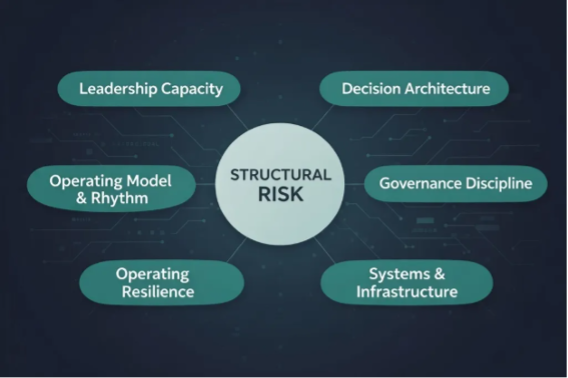
In private capital, the most costly risk is the one no spreadsheet captures: the strategy is right, the founder is committed — but the way the business is designed and built to operate reveals early indicators of a hidden threat to its ability to deliver value.
That hidden threat is Structural Risk — the misalignment between strategy and the organizational systemsrequired to enable a high‑performing business to pivot fast and thrive.
If left unaddressed, this misalignment shows up in the organization’s architecture: leadership capacity, decision design, governance discipline, systems and infrastructure, execution resilience, and operating model and rhythm.
When these elements aren’t aligned, the business doesn’t collapse. It strains. It slows. It compensates — until business performance eventually exposes what’s been true all along: the operating model isn’t designed to adapt with market changes, consistently meet financial and investment covenants, or provide the leadership bench strength needed to steer the ship.
Traditional pre‑deal due diligence focuses on what it should: financial strength; commercial opportunity; legal exposure; and market environment. These are essential lenses — but they tell only part of the story.
What ultimately determines whether an investment succeeds is something more foundational: Is the business structurally designed and built to evolve and carry the strategy behind the deal?
Answering that question requires a different lens — one focused on the underlying mechanics that drive performance and resilience. That’s where Structural Due Diligence comes in.
What Is Structural Due Diligence and Why it Protects Enterprise Value
Business performance always reflects the strength of the system surrounding the people. When that system isn’t built for the next stage, value doesn’t just stall — it begins to erode.
The pattern is predictable: integration delays, leadership turnover, rising operating costs, KPI drift, and ultimately, compressed exit multiples.
If financial due diligence protects the downside, structural due diligence protects the runway. Smart capital doesn’t fund ideas alone. It also funds the leadership and the organization needed to turn strategy into value.
Structural due diligence isn’t culture work or sentiment checking. It’s a disciplined assessment of how the system actually operates.
- How decisions are made
- How leaders lead
- How teams align
- Whether the structure can sustain scale
In short, Structural Due Diligence protects enterprise value by identifying execution risk before capital amplifies it.
How to De-Risk Investment Exposure
At Vantyx Partners, we apply Structural Due Diligence in the pre-deal stage to surface critical breaking points — because once capital accelerates a business, it magnifies every structural weakness already in place.
That’s why we developed the Structural Risk Index™ — a proprietary diagnostic that tests whether the organization can absorb the complexity required to execute its strategy. Conducted before capital amplifies structural strain, it translates hidden exposure into a prioritized activation roadmap.
Through the Index, we help CEOs, Founders and Investors:
🔹Identify hidden execution risks before capital is deployed
🔹Quantify leadership and operating exposure
🔹Map decision‑flow and accountability gaps
🔹Align governance to post‑close realities
🔹Build a 100‑day structural activation plan
To protect your investment, from avoidable execution risk — start with the Structural Due Diligence Checklist™ — your first step in determining whether structure can scale before capital is deployed.
For a full deployment of the Structural Risk Index™, within your pre-deal due diligence process or 100-day activation planning — connect with our team directly. We look forward to exploring the possibilities with leaders committed to building organizations that can truly carry their ambition.
Capital moves fast. Structure determines whether it turns ambition into return.
