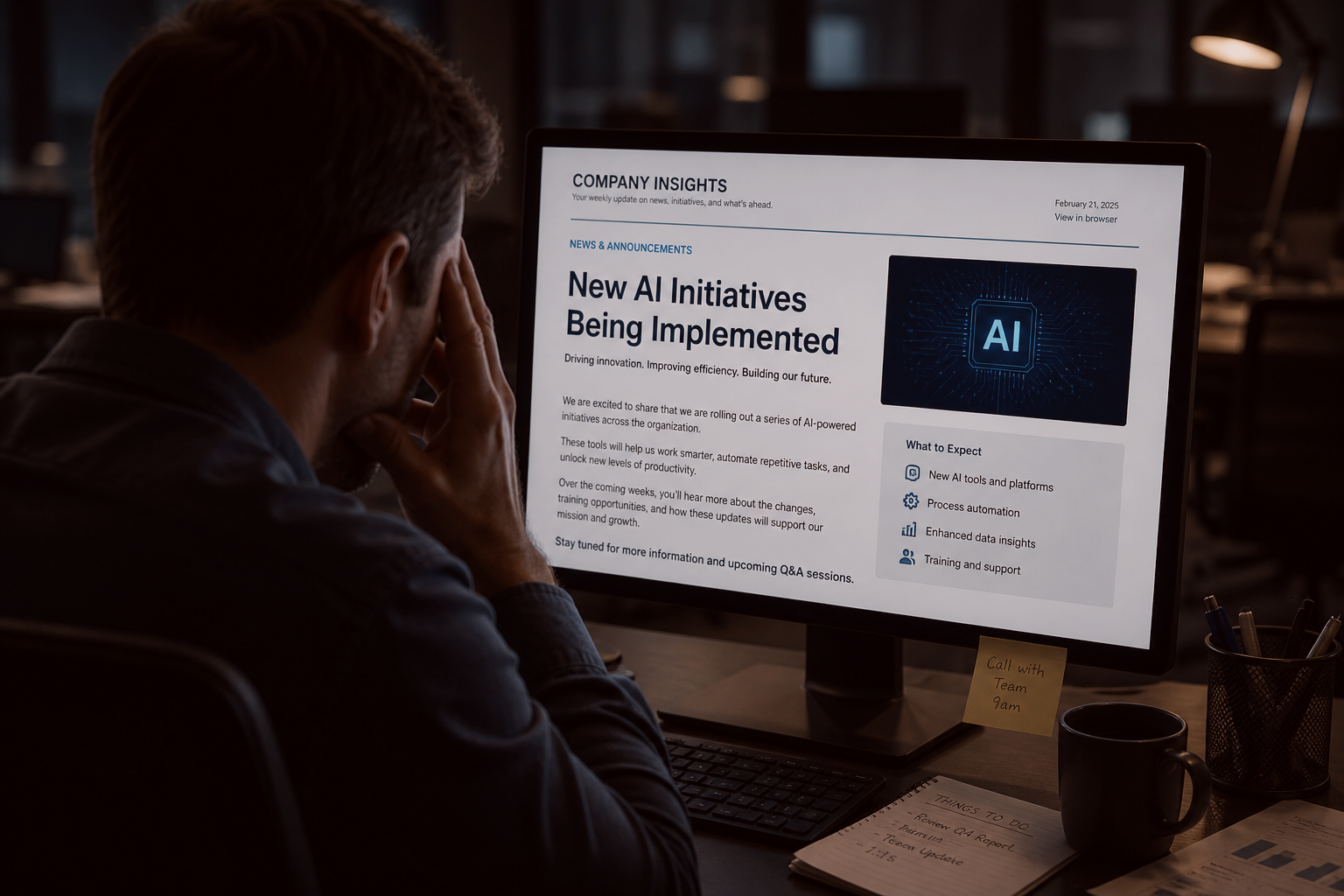
AI Isn’t What Your People Are Afraid Of
There’s a quiet shift happening inside a lot of companies right now.
It’s not in the boardroom decks or the earnings calls. It’s happening in the heads of your employees.
People are asking themselves questions they won’t say out loud.
“Is my role still going to exist in a year?”
“Am I already behind?”
“Are they building a system to replace me?”
This is the psychological impact of AI that doesn’t show up on a roadmap.
And if you’re in a leadership role, it’s your problem whether you acknowledge it or not.
Because fear doesn’t stay contained. It leaks into decision making, collaboration, and performance. It changes how people show up. It makes them more cautious, less creative, and less willing to take ownership.
Not because they don’t care, but because they’re protecting themselves.
Here’s the uncomfortable truth most organizations are avoiding.
AI is not what people are actually afraid of.
They’re afraid of how leadership will use it.
There’s a growing pattern that employees are starting to recognize.
A company struggles with inefficiency, bloated processes, or poor alignment for years. Then AI enters the conversation, and suddenly it becomes the explanation for workforce reductions.
“Automation.”
“Optimization.”
“AI-driven efficiency.”
But underneath it, the real issue was never the technology.
It was the operating model.
- Broken processes.
- Disconnected systems.
- Poor data discipline.
- Lack of clarity in roles and accountability.
AI just exposed it faster.
When companies use AI as a justification for layoffs instead of addressing those foundational issues, people notice. And once they do, trust erodes quickly.
Not just in leadership decisions, but in leadership intent.
That erosion is hard to reverse.
Because now every new tool, every automation initiative, every “efficiency” conversation gets interpreted through a different lens.
Not as progress, but as risk.
So what does responsible leadership look like in this moment?
It starts with clarity.
If AI is being introduced to improve how work gets done, say that. Show where it fits. Be explicit about what will change and what won’t.
Ambiguity is where fear grows.
Next is ownership.
If your organization has inefficiencies, own them. Don’t mask them behind technology. Fix the process before you automate it. Align the data before you scale it. Clarify roles before you augment them.
Otherwise, you’re not implementing AI. You’re accelerating dysfunction.
Then there’s investment in people.
The companies that get this right are not treating AI as a replacement strategy. They’re treating it as a capability shift.
They’re asking different questions.
“How do we elevate the work our people are doing?”
“What decisions should humans be making that they currently don’t have time for?”
“What skills do we need to build now to stay relevant later?”
That changes the conversation from fear to opportunity.
Finally, there’s transparency in tradeoffs.
Not every role will remain the same. Some will change significantly. Some may go away over time.
But people can handle difficult truths a lot better than they can handle uncertainty and misdirection.
When leaders are direct about what’s coming and why, it builds credibility. Even when the message is hard.
When they’re not, it creates a vacuum that people will fill with their own assumptions.
And those assumptions are almost always worse than reality.
AI is going to reshape how work gets done. That part is not up for debate.
What is still very much in your control is how your people experience that change.
You can either create an environment where AI feels like a threat that’s happening to them.
Or one where it feels like a tool they are being equipped to use.
That difference doesn’t come from the technology.
It comes from leadership.
#Leadership
#AI
#FutureOfWork
#OrganizationalChange
#WorkforceTransformation
#ChangeManagement
#TrustInLeadership
#OperationalExcellence
#BusinessTransformation