AI Didn’t Fail. It Just Told the Truth.
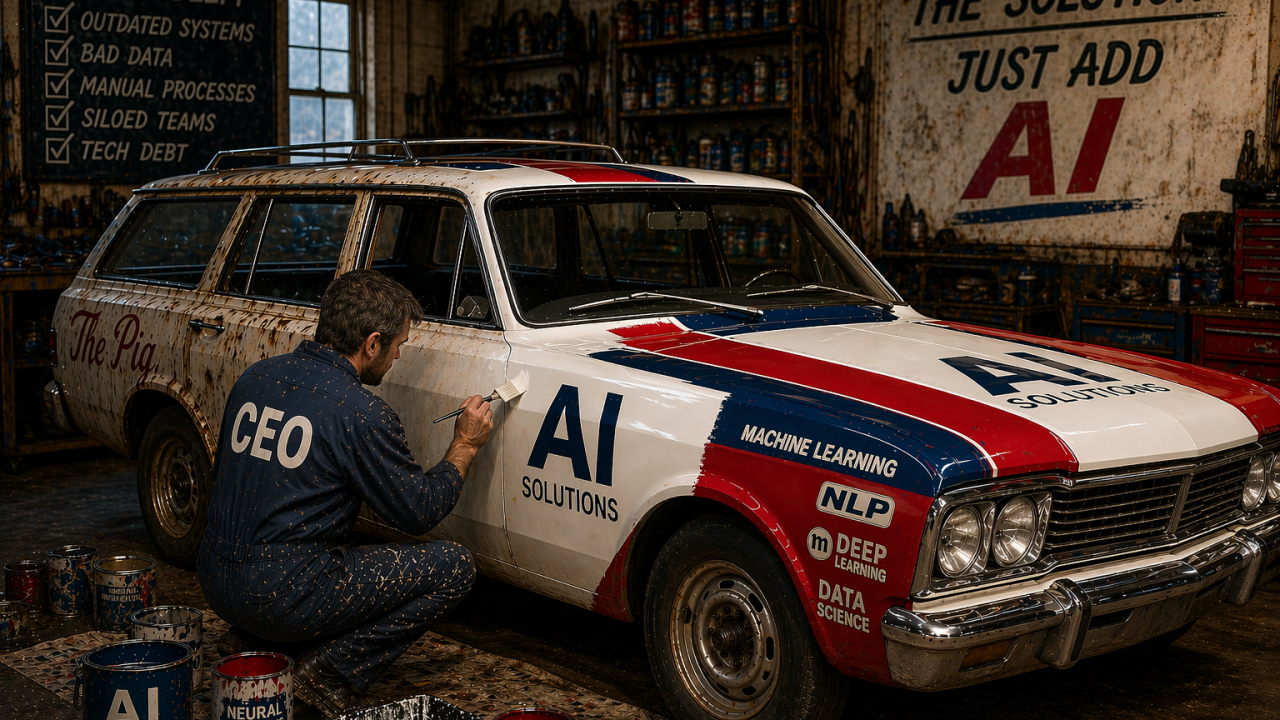
Most AI projects aren’t failing because of AI. They’re failing because of everything underneath it.
A few months ago, every conversation sounded the same.
“We need to figure out AI” or “we need AI now.”
Now those same companies are a little quieter about it.
The tone has shifted. It’s less excitement and more… confusion. In some cases, frustration.
Because a lot of these AI initiatives didn’t really go anywhere.
The demo worked. The pitch made sense. The tool looked impressive.
And then it got dropped into the business and nothing meaningfully changed.
Or worse, things got a little messier.
What’s interesting is how quickly the conclusion shows up.
“Maybe AI isn’t there yet.”
I don’t think that’s what’s happening.
What I’m seeing is AI doing exactly what it’s supposed to do. It’s just doing it in a way people didn’t expect.
It’s exposing things.
AI doesn’t operate on its own. It sits on top of whatever already exists in your business. Your processes, your systems, your data, your decision making.
If those things are clean and aligned, AI can be incredibly effective.
If they’re not, AI doesn’t fix them. It just makes the problems show up faster and more clearly.
I keep seeing the same pattern across different companies.
They try to automate something that was never clearly defined in the first place. So instead of getting speed, they get inconsistent outputs at a higher volume.
Or they plug AI into data that no one fully trusts. Multiple systems, conflicting reports, manual workarounds that have been living under the surface for years. AI doesn’t reconcile that. It just runs on whatever you give it.
Or they add another tool into a tech stack that already doesn’t communicate well. Now there’s just more moving parts and more confusion about where information is coming from.
And in a lot of cases, no one actually owns the outcome. AI becomes “something we’re trying” instead of something embedded into how the business runs. So when it doesn’t deliver, it just kind of… sits there.
That’s where the fatigue comes from.
It’s not really fatigue with AI. It’s fatigue from expecting a step change and getting a marginal improvement, or a new layer of complexity.
So people start pulling back. They get more cautious. Some start to question whether it’s worth the effort right now.
But that’s pointing at the wrong problem.
The issue isn’t that AI doesn’t work. It’s that most businesses weren’t ready for it to.
Not in a technical sense. In a structural one.
Most companies have grown into their operations. Processes were built as needed. Systems were added over time. Reporting evolved based on what leadership asked for in the moment.
It works well enough to run the business. Until you try to layer something like AI on top of it.
Then all the gaps become very obvious, very quickly.
In that sense, AI becomes less of a tool and more of a stress test.
It shows you where things break. Where things don’t align. Where the business is relying on workarounds instead of design.
The companies getting real value out of AI aren’t just plugging it in and hoping for efficiency.
They’re stepping back and asking better questions first.
- What should this process actually look like if it worked the way we want it to?
- What data would we need to support that?
- Where should decisions be made, and by who?
- How should our systems actually work together?
Once that foundation is there, AI becomes a multiplier.
Without it, it’s just another layer sitting on top of something unstable.
I don’t think we’re going to see AI slow down.
But I do think we’re going to see more companies realize that the real work isn’t the tool.
It’s everything underneath it.
#ArtificialIntelligence #AIFatigue #DigitalTransformation #BusinessOperations #OperationalExcellence #TechStrategy #DataQuality #ProcessImprovement #Leadership #ScalingUp